The Self-Taught Revolution: Why Formal Education Isn't Enough
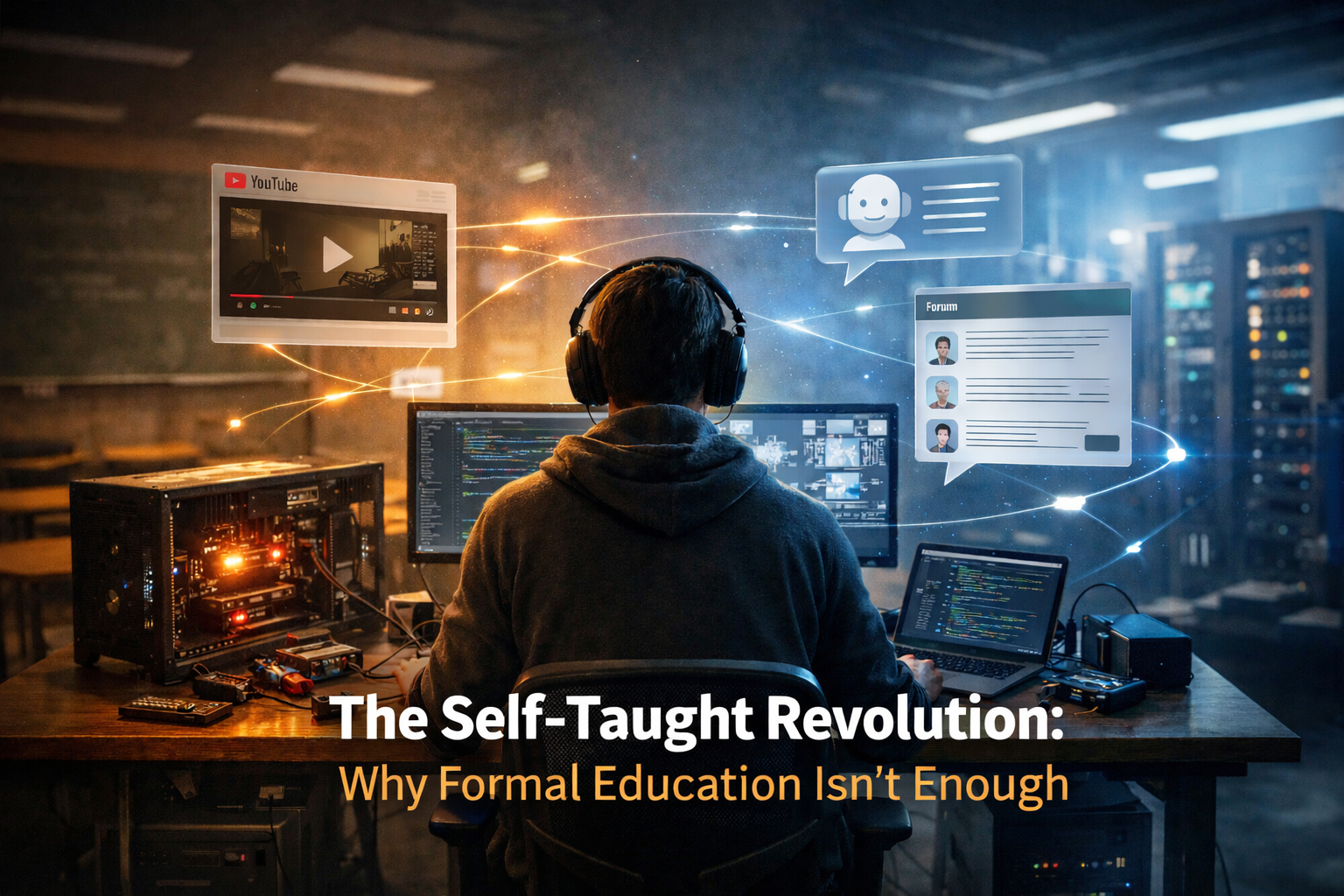
Today, a 13-year-old can learn to solder from a YouTube video, and a 40-year-old can learn to build a full-stack app in a week through a free online curriculum.
This informal skill mastery has become increasingly common across all age groups. Why go to school when you can learn while you're building something real? You run into an issue? Google it, ask AI, search YouTube, it's all there at your fingertips, and all you need to do is look.
The IT landscape easily falls into this category.
I'm a systems admin who doesn't have a traditional IT-based degree. As someone who enjoys tinkering with tech, I've learned through experimentation, research, and experience. I have no formal education directly related to my career. Given the number of people who enter IT from completely different careers, I'm surprised by how many can't believe my actual degree is in filmmaking.
The Democratization of Skill Acquisition
Historically, finding a great career required attending university.
There are benefits to this: you have structure, potential mentors in professors and peers, and in the end, you receive a piece of paper showing that you've been educated on the subject.
But... there are drawbacks.
Not everyone does well in a school setting. In most cases, you may not even build anything until later in the semester, and if you do, it is often a tutorial. The focus tends to be on learning the tools instead of building something that can be applied in the real world. (Some professors are forward-thinking and do give these opportunities. If you have one, they may be a great mentor for you.)
Attending college or university also creates a financial burden for attendees.
Today, we can learn the same thing at our convenience, without spending a dime. Platforms like YouTube, free online resources, a simple Google search, and, with the right prompting, even AI can help you build these valuable skills. Not everyone can learn this way. It requires a degree of agency, a self-starter attitude, and the discipline to sustain it.
I can hear the arguments now: "People who are self-taught lack credibility and quality of work." That concern is understandable to a degree. They don't have the official stamp of approval from a college or university to prove their skills. That, unfortunately, comes from a closed mindset.
That's also why I promote the idea of "Learning while doing."
Problem-Based Learning
The most effective way to learn and prove that you have a skill is to use it.
Problem-based learning is about building something while you learn the skill. You educate yourself by working directly on a real-world project. This involves every step from start to finish. If you run into an issue, you research, ask AI, and post in community groups like Reddit for help and understanding.
I followed this process and found success.
The reason I have been so successful as a systems admin is the projects I've worked on both at home and at my job. I wasn't afraid to take on something new and learn it. Sometimes it was setting up a hypervisor I've never worked with before for machine virtualization, other times it was experimenting with a new tool. Recently, I built a local LLM server running on Ubuntu Server 24.04 and a couple of AMD 6700 XT graphics cards. It wasn't an easy task, but I figured it out. If you're interested, you can read about the project here: (Link to Local AI on 6700 XT Post).
As you build your skills from these projects, you start to develop a portfolio of proof.
The Rise of the "Portfolio Career"
Job markets are ever-changing. The skills that you're stacking with each project provide you with more opportunities.
A portfolio career is when a professional crafts their work life like an artist builds a collection of pieces: each project or role adds depth, variety, and resilience to the whole. It's the proof that you can do the work.
I've been in IT for over a decade, and the changes in the field can be dizzying. There is always new software, technology, tools, and features to learn. It's probably why I gravitated to the field so seamlessly. I always have something new to learn and experiment with.
The experience, experimentations, and skill-stacking allow you to tailor your resume to fit different roles. The more skills you gain, the more options you have to include on your resume, like specialized LEGO blocks.
It's the reason I've been able to earn promotions and raises more often than others.
Self‑taught learners frequently encounter Imposter Syndrome, a chronic pattern of self‑doubt in which they feel like a fraud, question their competence, and fear exposure, even when evidence shows they are capable and deserving.
Don't let that stop you.
It's understandable to have that feeling, but your experience from "learning by doing" has already proven that you can do it. Remember, you have been building that skill and portfolio for a reason; put it to good use.
If you need support, there are online communities, mentors, Google searches, and AI.
But what if I don't have a "real mentor"?
Community-Driven Learning & Peer Support
The "Mentor" role has evolved in the Internet age.
There are now online instructors, creators, industry masters, and peer groups who serve this role. We even have AI tools that can provide guidance and feedback. It's best practice to have multiple. The different perspectives give you more to learn from.
Thriving online communities exist for nearly every skill—whether you're self-teaching or diving deep into a passion like 3D printing.
One place I look when searching for help with an issue is Reddit. The systems admin groups on there are full of great, knowledgeable people who are willing to help. I have found answers to so many questions or issues with a quick search on there.
What is exciting about community-driven learning is that you can niche down. If you specialize in Citrix or Azure Cloud Administration, there are groups you can join for those areas, giving you more direct support on those topics.
You'll notice that some will become mentors to others in the group, being the first to jump in and assist when asked.
Most online instructors and industry masters who built courses are willing to assist in whatever way they can to provide you with the most success, essentially becoming your mentor.
If someone is teaching you something, or better yet, giving you advice, their mindset is to want to see you succeed. It's a psychological science.
Do you notice how these all intertwine? You have an idea of something you'd like to build, create, or become, but you don't want, or have the money to spend on traditional schooling. You can find a free course on YouTube that will teach you. Through that, you "learn by doing" and join community groups while asking AI to help you when you run into an issue that the course can't solve. Now you have new projects and skills to add to your portfolio, which in turn helps you find that next job or client.
The "Self-Taught Revolution" is a growing trend.
Industries start by looking at experience first before schooling. It's only a matter of time before a college degree is required only for a few specific job types.
Are you learning a new skill? I'm always learning something new, trying to build my skill stack. Tell me about what you're learning and building in the comments. I'd love to hear about it.
